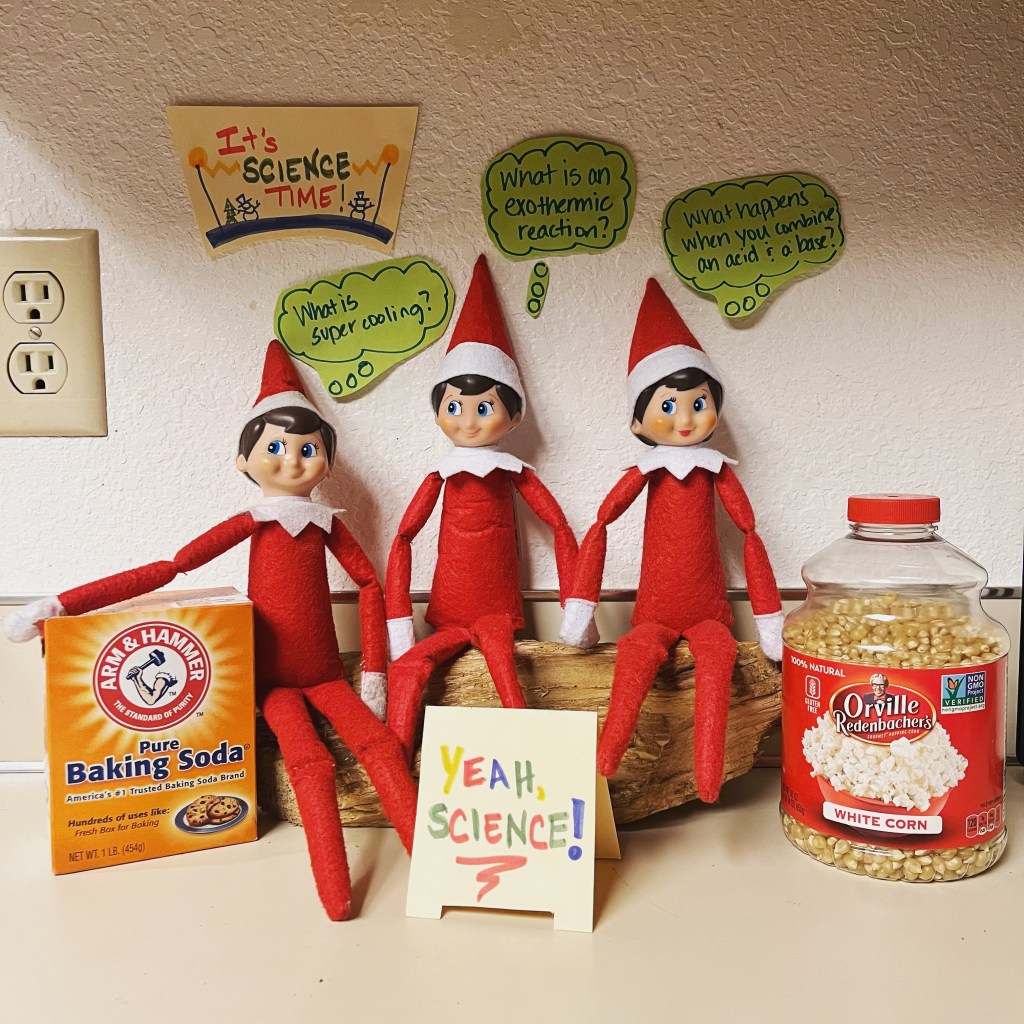
Th elves brought us more Christmas Science Experiments. Today’s projects were Dancing Popcorn and a Hot Ice Experiment.
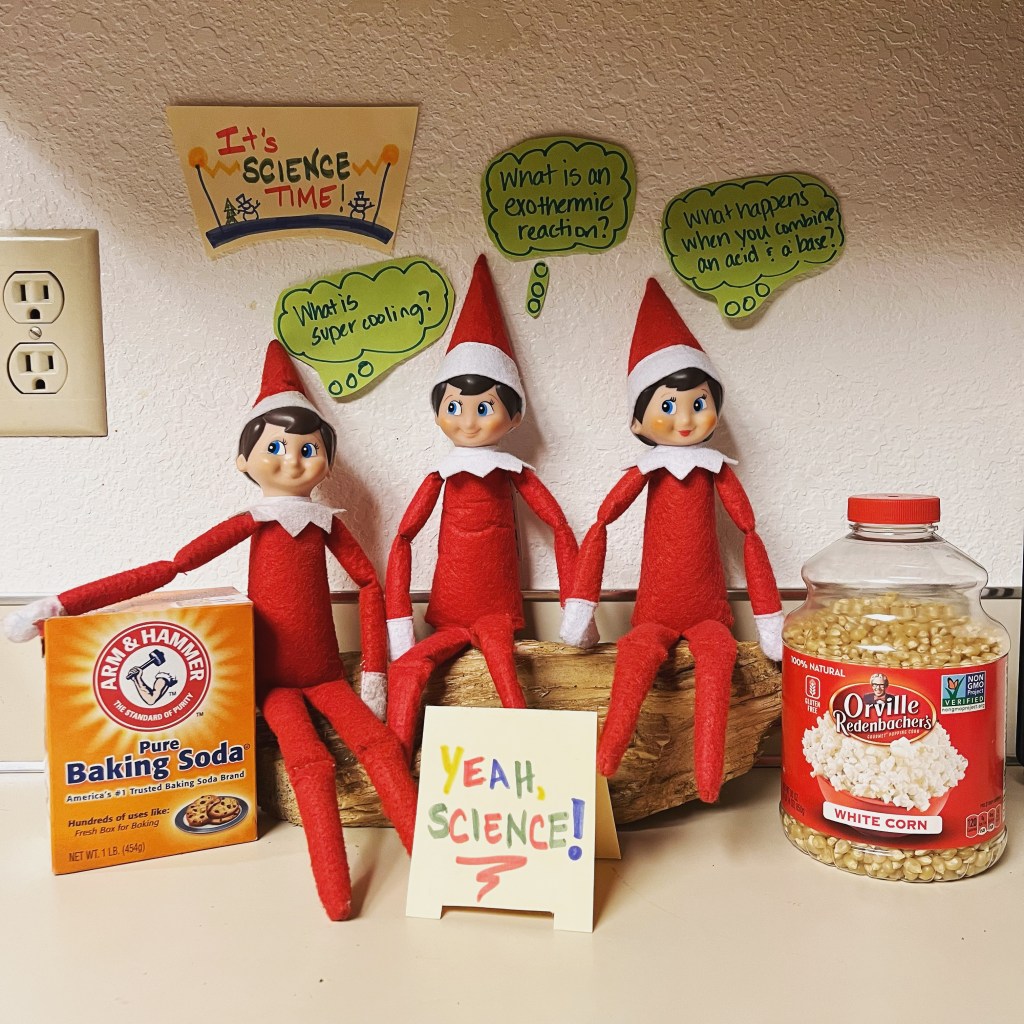
These fun projects kept my kids entertained for the evening. They learned about what happens when combining an acid and a base, exothermic reactions, and what supercooling is.
Take a 1/4 cup of popcorn kernels in a jar. Fill the jar 3/4 of the way up with water. Add 1 Tbsp of baking soda, stir in. Pour in 1/4 cup of vinegar and watch the popcorn “dance.”
As the bubbles are created, the carbon dioxide bubbles attach to the popcorn kernels and bring the kernels to the surface of the water. The bubbles pop when they reach the surface and then the popcorn kernels sink back down to the bottom of the jar. Once on the bottom they collect more carbon dioxide bubbles and the process starts again. This process is what makes the popcorn look like it is “dancing”.
For the Hot Ice project, we were able to reduce the baking soda and vinegar solution (3 Tbsp of baking soda with 3 cups of vinegar, boiled down on medium heat for about an hour). We put it in the freezer for 20 minutes. When we cooled the solution, we were able to bring the sodium acetate down to a temperature lower than the point at which it would normally become a solid. This is called supercooling. Then, when we poured the solution on top of some of the crystals from the pan. The solution hardened and was hot to the touch, which means it had an exothermic reaction. We will have to try the project another time though. The solution should have stacked up but ours spread out more like hot applesauce. But we still had fun learning!
Try out these science experiments with your kids this weekend!
 Spirited Essence Works
Leave a comment